

Selecting an advanced HRS Solution Provider requires evaluating how effectively compression, storage and dispensing packages communicate under continuous commercial refueling operations. Station reliability is not achieved by procuring disparate components from separate catalogs; it requires unified thermodynamic engineering, responsive control logic and coordinated safety systems. As an experienced HRS solution provider, Houpu integrates core hydrogen infrastructure into dependable, turnkey mobility facilities for global energy projects.
What Does an Integrated HRS Actually Include?
An integrated hydrogen refueling station incorporates multiple specialized subsystems into a synchronized fueling facility. High-pressure unloading manifolds receive bulk tube-trailer gas, feeding multi-stage diaphragm or hydraulic piston compressor skids that elevate pressure up to 45 MPa or 90 MPa. Specialized refrigeration heat exchangers pre-cool hydrogen delivery temperatures down to -20°C or -40°C, while cascade ground storage banks organize high-pressure gas into low, medium and high tiers. Finally, microprocessor-controlled dispensing pedestals meter gas to vehicles via calibrated mass flowmeters, infrared interfaces and breakaway nozzles.
Centralized station supervisory software and safety instrumented systems link these functional modules into a coherent operational plant.
Plant balance of plant includes closed-loop water chillers, instrument air compressors, nitrogen purging panels and uninterrupted power supply cabinets. Synchronizing these auxiliary systems ensures continuous station readiness during peak fueling hours.
How Does Compression Connect to the Rest of the Station?
The compressor serves as the mechanical heart of the refueling facility. Compression integration requires managing varying suction pressures from hydrogen tube trailers, which range from 20 MPa down to 2 MPa as gas is depleted.
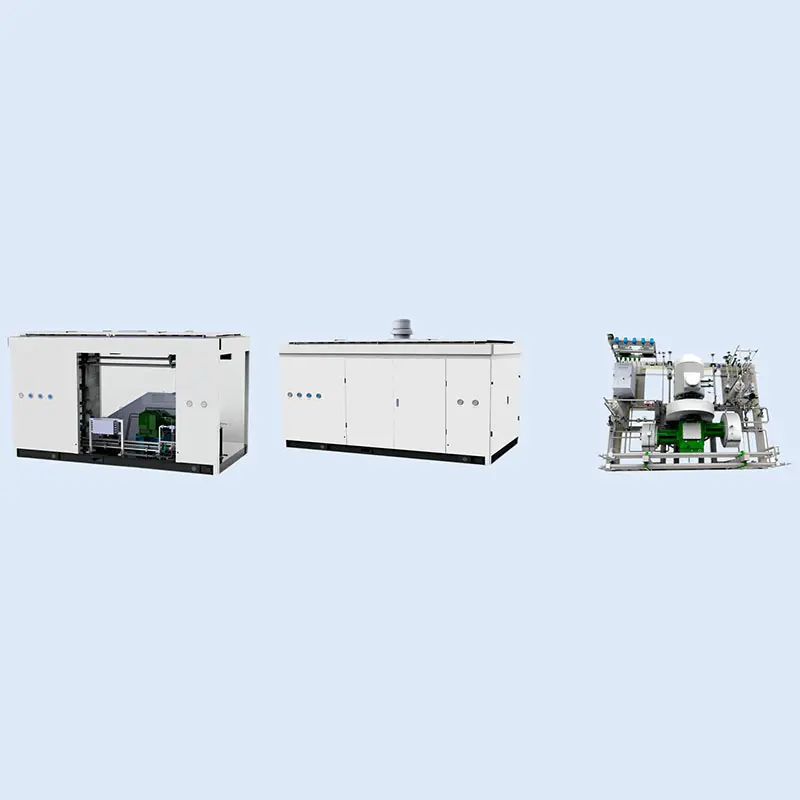
Automated compressor control logic modulates throughput, managing interstage gas cooling, pulsation damping and lubricating fluid separation. Compressor discharge feeds high-pressure storage cascades under automated priority sequencing, ensuring that gas is directed to the appropriate storage tier based on immediate station demand.
Coordinating compressor start-stop cycles with storage pressure thresholds minimizes mechanical wear and reduces auxiliary electrical consumption.
Interstage heat exchangers dissipate heat of compression, maintaining gas temperatures below critical limits before intermediate stages. Automated bypass loops recycle gas during startup, stabilizing compressor motor loads.
Why Is Storage More than a Pressure Vessel Selection?
Ground storage integration requires more than purchasing certified steel or composite pressure cylinders. An effective station incorporates a three-stage cascade arrangement comprising low-pressure, medium-pressure and high-pressure banks.
Automated priority sequencing valves manage gas flows between the compressor, storage banks and dispenser nozzles. During initial vehicle filling, gas flows directly from medium or low-pressure banks, conserving high-pressure gas for final vehicle tank top-off.
Intelligent cascade management reduces compressor operational run-hours and ensures rapid vehicle turnaround during peak morning and evening fueling windows.
Where Do Cooling and Priority Control Fit?
Hydrogen warms significantly during rapid throttling and compression due to its negative Joule-Thomson coefficient at ambient temperatures. To adhere to international safety standards such as SAE J2601, the station cooling unit must chill hydrogen gas to -20°C or -40°C before it reaches the vehicle receptacle.
Simultaneously, the priority control panel functions as the traffic director of the refueling facility. It routes gas between the compressor, intermediate storage tiers and the active dispensing nozzle. Intelligent priority logic ensures that low-pressure buffer banks are depleted first before high-pressure reserves are engaged, reducing compressor cycling and optimizing energy efficiency.
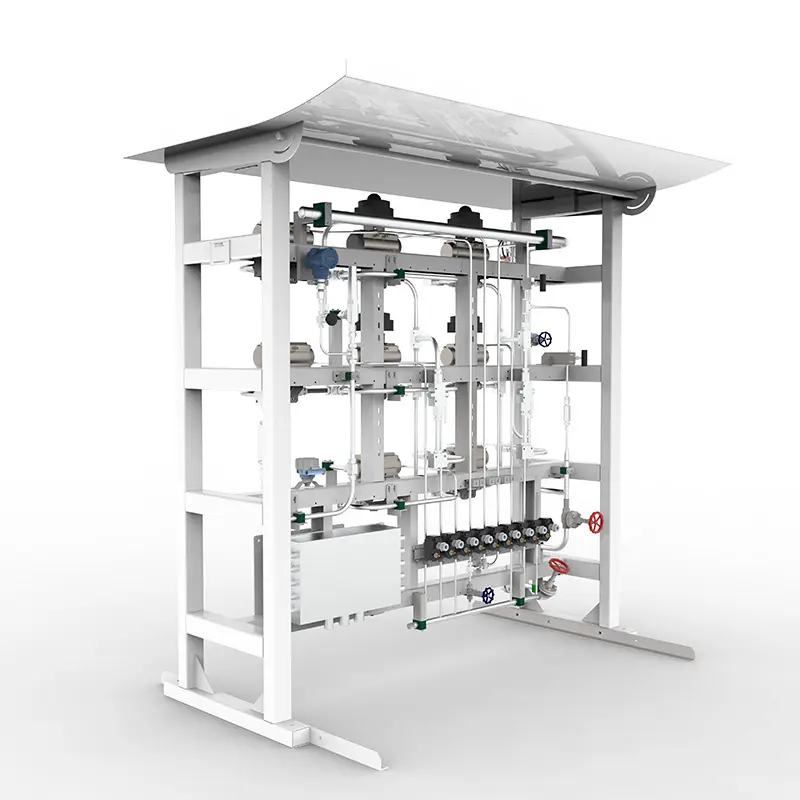
Maintaining accurate pre-cooling temperatures protects onboard vehicle composite cylinders from thermal stress during rapid high-pressure fills. Automated temperature transmitters modulate refrigerant flow rates in real time, matching dynamic dispenser mass flow.
Priority switching algorithms prevent pressure oscillations across active dispensing lines, ensuring stable mass flow delivery throughout back-to-back refueling cycles.
What Must the Dispenser Share with the Control System?
The hydrogen dispenser represents the final controlled stage of the delivery chain rather than an independent retail device. Houpu equips its intelligent dispensers with high-precision Coriolis mass flowmeters, infrared communications, automated breakaway couplings and high-speed emergency shut-off valves.
During refueling, the dispenser continuously exchanges operational telemetry with the central station programmable logic controller. It transmits real-time vehicle tank pressure, temperature and mass delivery ramp rates, verifying that cooling capacity and cascade supply pressure remain within safe operating envelopes.
If temperature or pressure limits are approached, the integrated controls modulate or halt flow immediately, ensuring complete operational safety.
Which Safety Functions Should Be Integrated at Skid and Station Level?
Safety engineering must operate cohesively across both individual equipment skids and overall station boundaries. Skid-level protections include canopy anti-hydrogen accumulation structures, localized flame sensors and automatic emergency vent valves.
At the station level, safety systems coordinate optical flame detectors, ambient combustible gas sensors and perimeter emergency shutdown buttons. Detecting an abnormal condition triggers immediate compressor shutdown, cascade storage isolation and nitrogen purge cycles.
Providing distinct alarm thresholds ensures that operators receive timely diagnostic warnings before automatic shutdown limits are reached.
Automated depressurization logic vents isolated pipe sections to designated safe atmospheric vent stacks equipped with flame arrestors, mitigating localized overpressure risks during emergency events.
How Can a Buyer Tell Whether a Provider Can Integrate the System?
Evaluating an HRS solution provider requires reviewing engineering documentation, interface management methodologies and factory testing protocols. Sourcing teams should request comprehensive piping and instrumentation diagrams, cause-and-effect interlock matrices and functional control descriptions.
A capable provider demonstrates in-house manufacturing of core components, specialized engineering teams exceeding 100 professionals, and established field commissioning procedures that guarantee operational harmony.
Procurement teams should verify that the supplier conducts complete factory acceptance testing, validating control communications and safety trips before hardware leaves the manufacturing facility.
What Do Houpu’s Project References Show?
Field integration capability was demonstrated at the Hanlan commercial mother station facility, where Houpu designed and commissioned the unified fueling architecture. The installation links on-site hydrogen generation with multi-stage booster compressors, cascade ground tanks and dual-nozzle dispensers operating at 35 MPa and 70 MPa. Unified instrumentation eliminated control latency and simplified statutory safety certifications.
Real-world delivery showcases turnkey capability in action. On September 7, 2026, Houpu fulfilled the international shipment of a 35 MPa containerized fueling station to an infrastructure client in Portugal. That deployment brought together gas boosting, vehicle dispensing instrumentation, plant safety controls and cloud-enabled diagnostics on a unified footprint.
In Southeast Asia, Houpu’s skid-type HRS project in Malaysia demonstrates its ability to deliver customized compression, storage and dispensing systems that satisfy stringent international quality and safety benchmarks.
These successful deployments prove that integrated system engineering prevents interface disputes, ensures adherence to local pressure equipment directives and accelerates commercial operation.
What Should Go into the RFQ?
An effective tender inquiry must state hydrogen supply source conditions, daily vehicle refueling demand, target vehicle pressure classes (35 MPa or 70 MPa) and local electrical utility limits.
Procurement teams should mandate clear definitions of battery limits, require factory acceptance testing of packaged skids, and detail commissioning and warranty support expectations.
Requiring bidders to supply detailed process flow diagrams and equipment datasheets during technical evaluation ensures that competing proposals are compared on an equitable engineering basis.
What Truly Defines an Advanced HRS Solution Provider: Subsystem Synchronization
A qualified HRS solution provider delivers synchronized thermodynamic engineering, robust hardware manufacturing and unified safety controls across compression, storage and dispensing packages. Houpu’s extensive engineering depth and proven project track record ensure dependable lifecycle performance for global hydrogen mobility infrastructure. Explore integrated station architectures at https://www.hqhp-en.com/.
Post time: Nov-19-2026


